

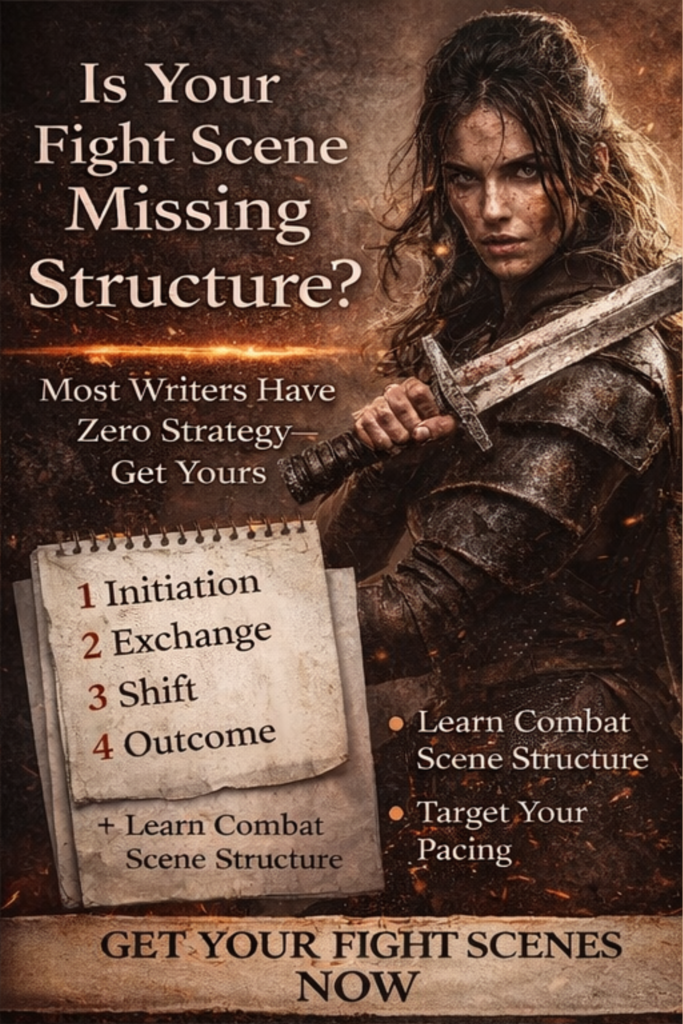
Most writers don’t struggle with ideas. They struggle with execution. You can have a strong plot, high stakes, and characters worth caring about, but the second a fight scene shows up, everything weakens. The movement becomes unclear, the impact disappears, and the reader disconnects. What felt intense in your head turns into something rushed or confusing on the page.
The issue isn’t that you don’t know what’s happening. It’s that you’re not translating it in a way the reader can feel. A fight scene is not about describing action—it’s about delivering impact, reaction, and consequence in a way that reads clearly and hits immediately.
Problem 1: Weak Verbs Kill Your Impact
Most fight scenes fall apart at the sentence level. Writers rely on safe, overused verbs that technically describe the action but fail to deliver force.
Common examples include:
- hit
- pushed
- grabbed
- moved
- went toward
These words are not wrong, but they are empty. They don’t show intensity, direction, or intention. A fight scene depends on precision. If the verb is weak, the entire moment loses weight.
Fix: Replace generic verbs with intentional ones.
Instead of writing:
- He hit him.
Write:
- He drove his fist into his jaw.
- He slammed him back against the wall.
- He hooked his arm and yanked him off balance.
The difference is not complexity. It is clarity and force. Strong verbs allow the reader to see and feel the movement at the same time.
Problem 2: You Stop at the Hit
Most writers describe the action and immediately move on. The hit happens, and then the scene continues as if nothing meaningful changed.
This is where fight scenes fail.
A hit is not the moment. The reaction is.
If you write:
She punched him in the stomach.
And then continue forward, the reader has nothing to connect to. There is no interruption, no shift, no consequence.
Fix: Always show what the hit does.
After every action, include at least one of the following:
- Physical reaction (staggering, collapsing, losing breath)
- Sensory reaction (pain, ringing ears, blurred vision)
- Emotional reaction (shock, anger, hesitation)
For example:
- Her fist drove into his stomach. His breath cut short, and he folded forward before he could recover.
Now the moment carries weight. Something changed.
Problem 3: No Consequences Means No Stakes
A fight scene without consequences is just movement. It may look active, but it does not matter. Readers stay engaged when actions lead to change.
If nothing shifts—position, power, control, or outcome—then the scene has no purpose.
Fix: Make every action alter the situation.
Ask yourself after each exchange:
- Who has the advantage now?
- What just got worse?
- What changed that can’t be undone?
You should be able to track the fight like progression, not repetition.
Problem 4: Confusing Movement Breaks the Scene
One of the fastest ways to lose your reader is unclear positioning. If the reader cannot visualize where characters are or how they are moving, the tension disappears.
This usually happens when:
- Too many actions are packed into one sentence
- The direction of movement is unclear
- The sequence of actions is out of order
Fix: Prioritize clarity over speed.
Keep movement readable:
- One action at a time
- Logical sequencing
- Clear positioning
For example:
- He stepped in first, closing the distance. She turned too late, and his shoulder drove into her side.
Simple. Clear. Easy to follow. That’s what keeps tension alive.
Problem 5: You’re Writing Without Physical Awareness
A lot of writers believe they cannot write fight scenes because they lack experience. In reality, you do not need to be trained in combat—you need to understand reaction and limitation.
You already know:
- What it feels like to lose balance
- How your body reacts under stress
- How pain interrupts movement
That is enough to start.
Fix: Use what you know—or write through your character.
If your character has training, let that guide the scene. Their instincts, their reactions, and their control become the structure you follow. You are not guessing—you are translating perspective.
What Strong Combat Writing Actually Looks Like
When these elements come together, your writing changes immediately. You are no longer just describing action. You are controlling how the reader experiences it.
Strong fight scenes include:
- Clear, forceful verbs
- Immediate and believable reactions
- Consequences that shift the scene
- Movement that is easy to follow
When those are present, the scene stops feeling flat. It starts to land.
Where Most Writers Go Wrong (And Stay Stuck)
Most writers read advice like this, agree with it, and move on. They tell themselves they will apply it later, when they have more time or when their writing feels more ready.
That delay is what keeps them stuck.
Skill does not improve through understanding alone. It improves through use.
What to Do Next (Simple, Not Overwhelming)
Do not try to fix everything at once. Focus on one controlled attempt.
Write a short fight scene—three to five sentences—and apply:
- One strong verb
- One clear reaction
- One real consequence
That’s it.
You are not trying to perfect it. You are training your awareness.
Because once you can feel the difference in your own writing, you won’t go back to writing flat scenes again.
Stay faithful, stay quirky, and stay writing.
With love and fire,
V.S. Beals
Writer. Watchwoman. Woman of the Word.
–> Wait There’s More – If You’re Serious About Writing Check Out All My Free Writing Resources
Follow Me on My WriterTok Account For All Things Writing
Check Out My Entrepreneur Articles If You’re Interesting In Business Opportunities & Stewardship
Follow Me On Pinterest For Writing & Entrepreneurship