Here’s what most writers get wrong about villains: they mistake cruelty for complexity. Your Villain doesn’t always have to be cruel, they can simply be misdirected or maybe, just maybe they don’t even know they’re the villain.
They give their antagonist a dramatic backstory, a signature weapon, and a monologue that sounds menacing in a vacuum — and then wonder why readers don’t feel the story in their chest. Why the hero’s victory lands flat. Why the conflict never really bit.
The problem isn’t the villain’s behavior. It’s that the behavior has no psychological architecture underneath it.
The villains that stay with us — the ones that make readers sleep with the light on or set a book down to stare at the ceiling — aren’t simply bad. They’re legible. You can follow the logic of how they became what they are, even if you’d never go there yourself. That’s the difference between a villain who disturbs you and one you forget by chapter three.
This piece breaks down five of the most psychologically potent villain types that writers consistently underuse. Not the full picture — that’s what the workbook is for — but enough to show you what’s actually at stake when you’re building an antagonist.
1. The Resentment and Injustice Fixation Villain
They were wronged — and they never let it go.
This is the villain most writers reach for instinctively, and most writers still get wrong. The fixation villain isn’t just angry. They’ve built an entire internal courtroom where the trial never ends, the verdict is always in their favor, and the sentence keeps escalating.
What makes them dangerous on the page isn’t their rage — it’s how reasonable their origin wound is. The original injustice is often real. Valid, even. The reader gets it. And that’s exactly the mechanism: you nod along with their grievance until you realize their response long ago stopped being proportionate. They don’t want justice anymore. They want balance corrected in a way that has become its own form of harm.
What this looks like in the body:
- Jaw set. Stare that lingers too long.
- Silence that isn’t absence — it’s weight.
- Every small interaction filtered through the original wound.
The line that runs through their internal monologue: “Someone has to answer for this.” “I didn’t deserve that.” “No one paid for what they did.”
This villain’s danger isn’t their capacity for violence. It’s their capacity for patience. They’ve been replaying, reliving, rehearsing — circling the same wound for years. By the time they act, they’ve rehearsed every justification. They’re not reactive. They’re ready.
2. The Control vs. Chaos Obsession Villain
They either fear chaos… or worship it.
This type runs two directions, and both are compelling. Some villains create rigid systems, rules, and hierarchies because unpredictability once cost them something catastrophic. They don’t want domination for its own sake — they want a world they can predict. Their cruelty is managerial: efficient, justified, and dressed in logic.
The other version burns everything down. Not because they’re nihilistic, but because chaos feels like truth to them. Like freedom. The structures everyone else clings to are, to them, the real lie — and they’ve appointed themselves the one willing to expose it.
Both versions share a fatal flaw: they cannot tolerate the in-between. The first villain can’t survive ambiguity. The second can’t survive stillness. And that psychological brittleness is exactly where your protagonist can find leverage — not by overpowering them, but by introducing what they cannot hold.
Writing this villain well means deciding early: does order or chaos represent safety to them? The answer shapes everything — how they speak, who they protect, what they destroy first.
3. The Messiah Complex Villain
They believe they are the only one who can fix what’s broken.
The most seductive antagonist type on this list, and arguably the hardest to write poorly because the character genuinely believes their own mission. They’re not posturing. They’ve constructed a framework in which they are not just justified but necessary. Their harm isn’t incidental to their goal — it is the goal, dressed in sacrifice language.
This villain is terrifying precisely because their logic can be followed. Strip away the scale of their actions and you find someone who genuinely believes they’re suffering for others, not against them. That’s not manipulation — it’s conviction. And conviction, written well, is harder to argue with than malice.
The narrative trap writers fall into: making this villain too obviously wrong too early. The reader needs to feel the pull of their worldview before they see the rot in it. Otherwise, you haven’t written a Messiah Complex Villain — you’ve written a self-righteous caricature.
4. The Fear of Powerlessness Villain
At some point, they were helpless. Now? Control is everything.
This is the villain who is, at their core, still a version of the person who once had no options. Something — a person, a system, a moment of catastrophic vulnerability — marked them. And the entire architecture of who they’ve become is a response to ensuring that never happens again.
Every act of cruelty is really a preemptive strike against helplessness. Every power move is a wall built against the memory of having none. They don’t necessarily enjoy harm — they require it as proof that they are no longer that person on the floor.
The craft opportunity here is enormous. A well-written Fear of Powerlessness Villain gives your protagonist something more difficult than a monster to fight: a mirror. Because almost every protagonist has experienced powerlessness. The question the story implicitly asks — what did you do with yours? — gives the conflict moral weight that a straightforward good-vs.-evil frame can’t.
5. The Moral Justification Villain
They don’t see themselves as the villain. They’ve built a framework where their actions are necessary, logical — even righteous.
This is the one that should keep you up at night as a writer, because it’s the one that keeps readers up at night as humans. The Moral Justification Villain isn’t hiding their beliefs — they’re proud of them. They’ve done the philosophical work. They have a framework. They can defend their position point by point.
And sometimes? Parts of their argument land.
That’s the craft challenge: the reader has to see the seams in the framework without the story simply telling them it’s wrong. Because the moment you editorialize — the moment the narrative tips its hand too early — you’ve robbed the reader of the intellectual discomfort that makes this villain worth writing.
This villain doesn’t escalate through emotion. They escalate through logic. Every harmful act follows from a premise they established pages ago. Your reader, if you’ve done your job, watched them build it. And now they have to watch it play out.
Why Most Villain Scenes Fall Apart Before the Action Starts
You can nail the psychology. You can know exactly who your villain is and why they do what they do. And the scene can still feel dead on the page.
Here’s why: psychology is the why, but the scene lives in the body.
A Resentment Fixation Villain who brood and plots doesn’t come alive until you know what their jaw does when they finally see the person who wronged them. A Messiah Complex Villain doesn’t land until you can feel the particular warmth in their voice when they explain what they’re doing to you. These things aren’t decorative. They’re how psychological interiority becomes physical reality — which is the only way readers actually feel it.
This is especially true in fight scenes and confrontations, where writers often abandon character psychology entirely and default to choreography. But a villain who fights with no psychological signature is a villain who disappears mid-scene. The most memorable confrontations are ones where even in the violence — especially in the violence — you can still feel who they are.
The Two Resources That Work Together
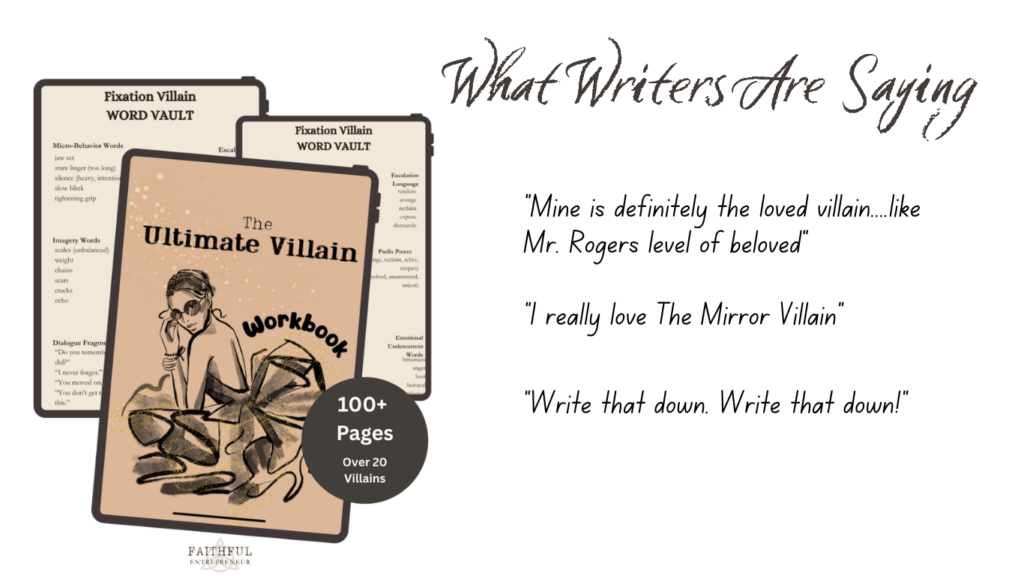
The Ultimate Villain Workbook
This workbook covers 27 villain psychological archetypes — each with its own Word Vault: the specific verbs, adjectives, imagery language, micro-behavior descriptions, and dialogue fragments that belong to that villain type. Not generic “dark” vocabulary. The language that is specific to how this kind of person moves through the world, speaks, and escalates.
If you’ve ever written a villain scene that felt thin and couldn’t diagnose why — this is likely the missing layer. Knowing that your character is driven by resentment isn’t enough. Knowing that their fixation language loops, replays, and circles — and having the exact vocabulary to render that on the page — is what turns a character concept into a character.
[Get the Ultimate Villain Workbook →]
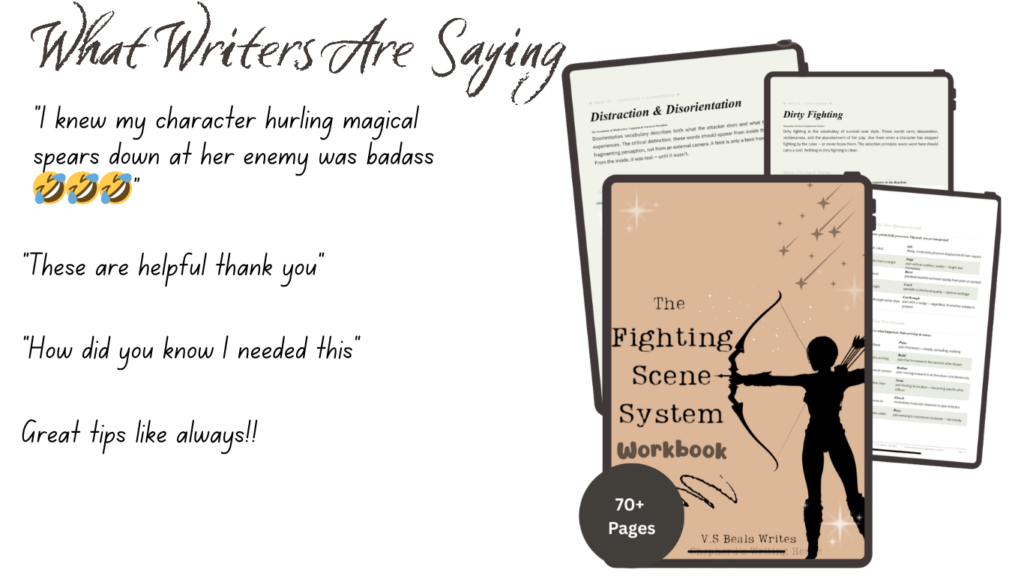
The Fighting Scene System
This is the companion piece your villain work needs once you get into confrontation scenes. The system covers how to build fight scenes that are psychologically grounded in your specific characters — not just action sequences that could belong to anyone.
Because the way a Fear of Powerlessness Villain fights is not the same as the way a Moral Justification Villain fights. Their body language is different. Their escalation triggers are different. Their tells are different. And if your fight scene doesn’t reflect that, you lose the characterization you spent chapters building — right at the moment readers are most engaged.
The Fighting Scene System gives you the structural framework to ensure that every fight scene, every confrontation, every moment of physical conflict reveals rather than just happens.
[Get the Fighting Scene System →]
The Real Work
Both resources exist because the writing advice that says “just make your villain three-dimensional” without telling you how is more frustrating than no advice at all.
Three-dimensional means rooted in a specific psychology. It means language that belongs to this kind of person. It means fight scenes that don’t strip away what you built. It means the villain’s logic is coherent enough that readers have to sit with it.
The five villain types here represent a fraction of what the workbook covers. Twenty-two more psychological frameworks. Twenty-two more Word Vaults. And the structural tools to bring them into contact with your protagonist in ways that feel earned.
Because the real measure of a villain isn’t how much damage they do. It’s how much the reader understands — against their own better judgment — exactly how they got there.
Writing craft, character work, and the tools that actually move the needle
Stay faithful, stay quirky, and stay writing.
With love and fire,
V.S. Beals
Writer. Watchwoman. Woman of the Word.
Check out Last Week’s Article