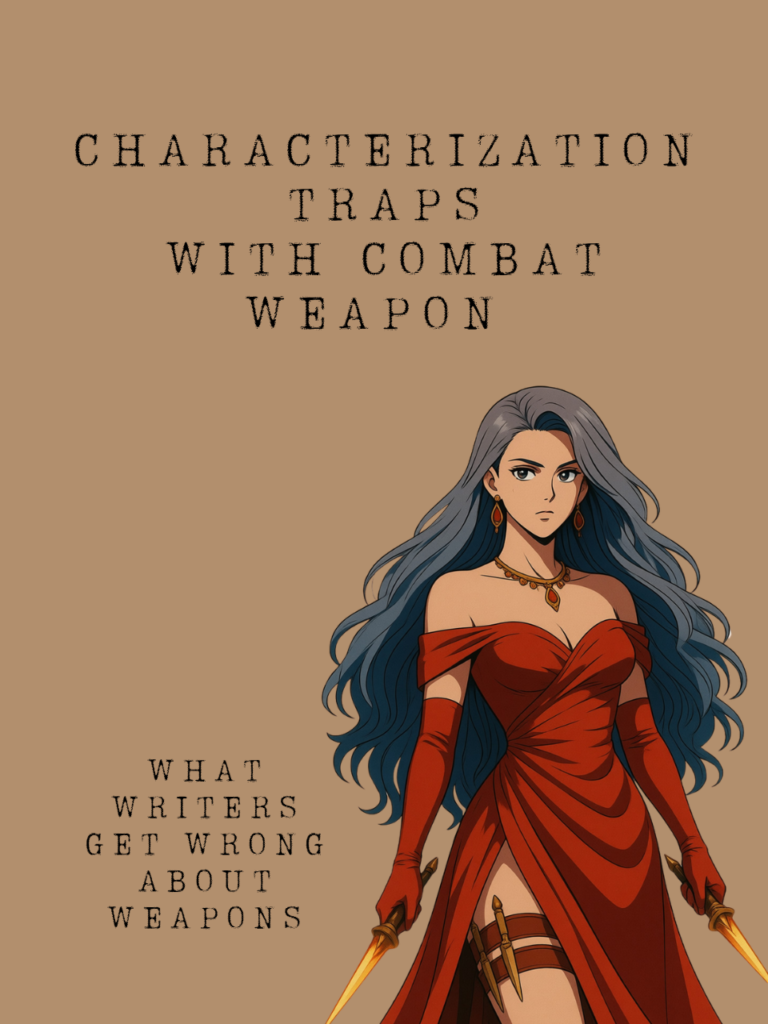
A weapon is a characterisation choice. Yet writers can spend hours deciding what their characters looks like, how they speak, what they wear, and how they behave, only to hand them a weapon because it looks impressive.
Stop there. Ask yourself, why that weapon? Why would this character choose it? And what does that choice tell us about the person carrying it?
If you cannot answer those questions, you may have chosen a weapon for its appearance rather than its place in the character’s construction.
I listed below 12 of the most common traps.
1. The Weapon Equals the Personality
A sword does not make your character honourable. A dagger does not make them deceptive. A firearm does not automatically make them ruthless. Those are associations, not character traits.
Your character’s personality comes from their beliefs, decisions, experiences, and behaviour. The weapon may reinforce those qualities, contradict them, or have very little to do with them.
The question is not what personality belongs to this weapon. It is why this character carries it.
2. Choosing Appearance Over Character
Yes, that sword looks magnificent. The dagger looks intimidating. The bow fits the aesthetic you have in mind for your heroine.
Now tell me why they carry it. Does it suit their background? Do they have the training to use it? Is it available in the world you have built? Does it serve a purpose that matters to them?
A weapon can be visually striking and still be the wrong choice for the character.
Aesthetic appeal is a design consideration. It is not character development.
3. Relying on Weapon Stereotypes
Writers often inherit familiar associations without examining them, their benefits or limitations for that particular character. The sword belongs to the noble warrior. The dagger belongs to the assassin. The bow belongs to the quiet, patient hunter.
Those associations can be useful. They become a problem when you treat them as general rules.
So what happens when the swordsman has no interest in honour? What happens when the dagger-wielder is neither secretive nor deceptive? What happens when the archer is impatient, impulsive, and terrible at waiting? You get now what I’m asking? Now you have something worth developing.
Use an association deliberately. But do not mistake it for a personality.
4. Ignoring Why the Character Chose It
Your character carries a weapon. That is a fact.
Why that weapon?
Perhaps they trained with it from childhood. Perhaps it belonged to someone they lost. Perhaps their profession requires it. Perhaps they chose it because it suits their circumstances better than the alternatives. Perhaps someone else chose it for them. Each answer gives you a different character history and a different set of possibilities for the story.
You do not need to explain the entire history in the first chapter. You do need to understand the choice yourself.
When you know why they chose the weapon, you have something to write beyond the fact that they carry it.
5. Confusing Weapon Choice With Skill
Carrying a sword does not make someone a swordswoman. Owning a bow does not make someone an accomplished archer.
A weapon and the ability to use it are two separate things. Try to consider the character’s training, experience, familiarity, and limitations. Have they spent years practising? Have they only recently acquired the weapon? Do they understand its demands, or have they mistaken possession for competence?
Your character’s skill should be supported by her history and demonstrated through her actions.
Do not give a character expertise that her story has not earned yet.
6. Forgetting the Character’s Background
A weapon does not exist outside the world in which the character lives.
Consider where she grew up, what resources she could access, who trained her, what her occupation requires, and which weapons are familiar or available in her culture. A weapon that makes perfect sense for a soldier raised in a military household may be an unusual choice for a character who has never encountered one. That difference can be intentional, but the writer should understand it.
Background is not a decorative paragraph in a character profile. It influences the choices available to that character.
If the weapon contradicts their background, make sure you know why.
7. Giving Every Character the Same Fighting Identity
Two characters can carry the same weapon without being the same kind of fighter.
One may value tradition. Another may have inherited the weapon and feel no particular attachment to it. A third may have chosen it for practical reasons and care very little about what it represents.
Their relationship with the weapon can differ as much as their personalities do.
Do not assume that giving several characters the same weapon gives them the same identity. Equally, do not force every character to carry a different weapon simply to make the cast look varied.
Distinction comes from the character, not merely the equipment.
Grab Your Free 36 Character Questions To Help You Build A Stronger Character
8. Treating the Weapon as Decoration
The weapon appears in the character description. It hangs at her side. She draws it when the scene demands a dramatic moment.
And then it disappears from the story until the next fight.
If the weapon matters to the character, consider how that relationship manifests beyond its appearance. Is it familiar to her? Does she maintain it? Does she avoid discussing its history? Does she resent carrying it? Does she treat it as a responsibility, a possession, or a reminder?
Not every weapon needs an elaborate backstory. But if you want it to contribute to characterisation, it needs a meaningful place in the character’s life.
A weapon becomes part of characterisation when the relationship matters, not simply because the object is present.
9. Ignoring Practical Limitations
Your character may love the appearance of a particular weapon. That does not mean carrying it makes sense in every circumstance.
Consider its weight, portability, maintenance, availability, and suitability for the setting. Consider what carrying it requires and what limitations it creates. These details are not there to turn your novel into a technical manual. They are there to keep the character’s choices consistent with the world and circumstances you have established.
A writer does not need to explain every practical consideration to the reader. The writer does need to account for the ones that affect the story.
A dramatic choice still needs to make sense within its circumstances.
10. Confusing Sentimental Value With Practical Choice
An inherited sword may be precious to your character. It may connect her to her family, her culture, or someone she has lost.
That emotional significance does not automatically make it the most suitable weapon for her circumstances.
And that distinction is useful.
Perhaps she carries it because abandoning it would feel like abandoning the person who gave it to her. Perhaps she keeps it even though she struggles with its significance. Perhaps the weapon represents an identity she is trying to accept—or escape.
Now the object has meaning beyond its appearance.
Sentimental value explains an attachment. It won’t automatically explain every practical decision.
11. Assuming the Reader Will Interpret It as Intended
You may associate a sword with honour, a dagger with secrecy, or a firearm with ruthlessness.
Your reader may not share those associations.
Readers bring their own experiences, cultural references, genre expectations, and interpretations to a story. You can establish context and guide their understanding, but you cannot dictate every conclusion they draw.
If you want a weapon to carry a particular meaning, develop that meaning through the story. Show why it matters to the character. Establish the history, circumstances, or behaviour that supports the association.
Do not assume that the reader will understand an intention you have never communicated.
You control what you put on the page. You do not control every interpretation of it.
12. Explaining the Symbolism Instead of Developing It
A writer may want an inherited blade to represent grief, a family weapon to represent duty, or a character’s firearm to represent the life she has chosen.
Those meanings can work. The problem begins when the writer explains the symbolism repeatedly instead of allowing the story to establish it.
Let the reader see what the character does with the weapon, how she responds to its history, what she refuses to do with it, or what changes when her relationship with it changes.
Meaning develops through context, action, and consequence. It does not become more convincing simply because the narrator explains it again.
Do not tell the reader what the weapon represents and assume the work is finished. Make that meaning matter to the character.
The Question to Ask Before Choosing a Weapon
Before you give your character a sword, dagger, bow, crossbow, knife, or firearm, ask yourself one question:
Why this weapon for this character?
Not because it looks impressive. Not because a familiar character archetype carries it. Not because you need something for the fight scene.
Why does it belong to her/him?
Your answer does not have to be complicated. It does, however have to be intentional.
The weapon is one of the choices you make when building a character. Treat it with the same consideration you give her history, personality, motivations, and decisions. Because the weapon does not build the character for you.
The character gives the weapon its meaning, not the other way around.
You Know Your Character’s Details. But Do You Know Who She Is?
You can give a character a name, a history, a family, a career, and a list of personality traits without ever understanding what makes her tick. The real work begins when you start asking questions that go beyond the obvious.
That is where the 36 Questions to Create Characters Who Actually Feel Real comes in.
This free questionnaire gives you 48 questions across 12 character-building pillars to help you investigate the person behind the profile—from her motivations and contradictions to the beliefs, behaviours, and relationships that shape who she/he becomes on the page.
Whether you are creating a new protagonist or trying to understand a character you have already written, these questions give you a practical place to begin.
Download your free copy and start building characters who feel like people, not profiles.
Stay faithful, stay quirky, and stay writing.
With love and fire,
V.S. Beals
Writer. Watchwoman. Woman of the Word.
Have you read our last article?